
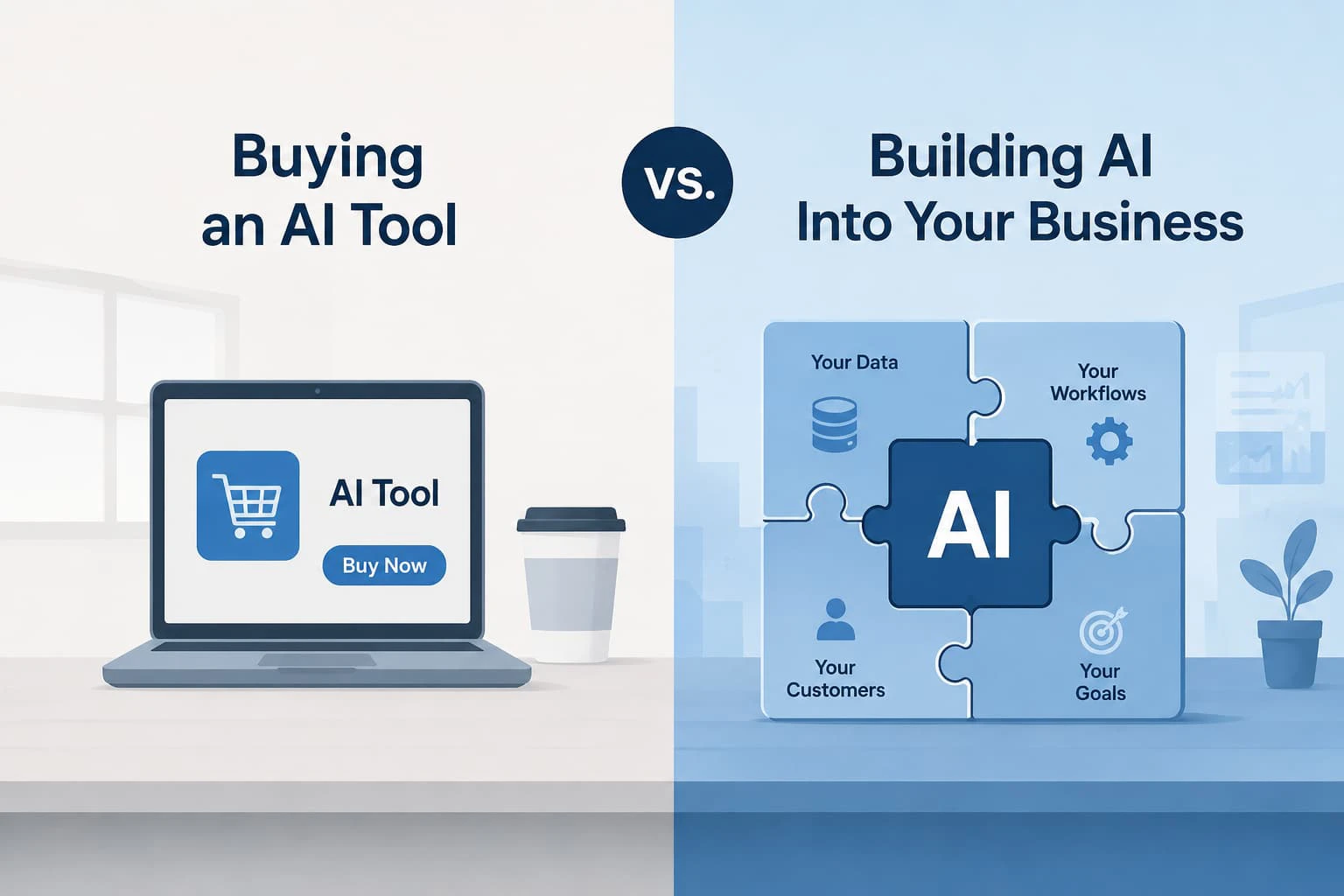

Businesses face a massive choice today. You can swipe a credit card for software. You can also build your own system. Both paths change your workflow completely. Renting a tool gives you fast results. Building custom software creates a long-term asset. Many leaders confuse these two paths. They waste thousands of dollars on the wrong choice.
Look at real data before you decide. OpenAI has millions of weekly active users buying tools. Yet, tech companies spend millions building custom models. Your choice impacts your data security. It also impacts your daily operational costs. You must understand the true differences right now.
What Does Buying an AI Tool Actually Mean?
Buying an AI tool means you rent software. You pay a monthly fee to use it. Think of renting a house. You cannot change the walls. You just live there. You sign up online quickly. The software runs on another company’s servers.
Look at ChatGPT Plus. Users pay twenty dollars every month. They get fast access to smart chat. They cannot see the code. They just use the preset features. You get speed but zero true ownership.
What Does Building AI Into Your Business Actually Mean?
Building AI means creating custom software. You own the code completely. Think of building a house. You choose the layout. This path uses AI agent development for custom automation. You connect your own database to the system. The software fits your exact workflow.
Consider modern shipping companies. They write custom code to track packages. They do not buy basic tracking apps. They build unique models. This creates a powerful asset. You control everything.
Key Differences Side by Side
Buying and building lead down two separate roads. The chart below breaks down the main facts.
| Feature | Buying a Tool | Building Your Own |
|---|---|---|
| Upfront Cost | Very low | Very high |
| Setup Time | Minutes | Months |
| Control | None | Full |
- Cost structure: Buying means low monthly fees. You pay per user. Building requires huge upfront money. You pay developers high software wages.
- Time to value: Bought tools work today. You log in and type. Building takes months of planning. You must write code and test it first.
- Flexibility: Rented software has fixed buttons. You cannot change how it works. Custom code changes whenever you want. You adapt it to your team.
- Data Ownership & Privacy Control: Bought tools send data to outer servers. This creates real privacy risks. Built systems keep data inside your company. You own every byte safely.
Signs You Should Just Buy a Tool
Choosing the wrong path drains your company funds. Buying software makes sense for specific situations. Look for these clear signs in your daily operations.
- Small team, simple repetitive task: Your small team has limited hours. You need to write basic email replies. You need to summarize meeting notes. Buying a standard app solves this instantly. A content team of three people uses Jasper. They create blog drafts in minutes. They do not need custom code for simple writing. Standard tools handle these basic jobs perfectly.
- No technical resources in-house: You do not employ software engineers. Your team knows sales or marketing instead. Building software requires great technical skills. You cannot build without developers. A local real estate agency needs AI chat. They buy a ready-made chatbot. They plug it into their website homepage. No code is required for setup. The tool works without an engineering team.
- Budget under $500/month: Custom software development costs thousands of dollars. A small budget cannot cover developer salaries. Buying lets you access great tech cheaply. Many startups spend fifty dollars monthly on Claude. They get top-tier intelligence for cheap. They save their cash for core business needs. Cheap tools protect your fragile cash flow.
Signs You Should Build Instead
Renting software has distinct limits. Sometimes buying fails to solve your core problems. You must build your own system when growth stalls. Look for these critical indicators in your business.
- The task touches proprietary or sensitive data: Your business handles private customer records. You manage secret product designs. Rented tools send this data to outside servers. This creates massive legal risks. A private clinic cannot upload patient charts to public tools. They build a secure in-house system instead. This keeps health data safe inside their private network. Security requires total control over your code.
- You need something no off-the-shelf tool does: Standard tools fit standard workflows. Your business might use a highly unique process. Ready-made software cannot handle your specific logic. A manufacturing plant predicts machine breakdown using custom sensor data. No basic app understands their old factory hardware. They write custom software to track these exact vibrations. Custom problems require custom engineering.
- You’re scaling past what manual tool-switching can handle: Your team wastes hours copying data between different apps. Employees manually move text from one tool to another. This manual work slows your growth. A logistics firm handles ten thousand orders daily. Staff cannot copy addresses by hand anymore. The firm builds an automated system to link its databases. Building removes the human speed limit completely.
How to Decide: A Simple Framework
Making the final choice requires a clear plan. Do not guess your next move. Follow these 4 simple steps for this:
Step 1: Define the specific problem
Write down the exact task you want to automate. Avoid vague goals like improving efficiency. Name the precise bottleneck. A retail shop wants to sort customer complaints automatically. They define the target as reading incoming email text. Knowing the exact problem limits your software search.
Step 2: Estimate volume
Count how many times you run this task daily. Low numbers mean you should buy tools. High numbers justify building code. If you process ten emails daily, buy a tool. If you process ten thousand emails, build a system. High volume makes custom engineering profitable.
Step 3: Check your data
Look at your current databases. Note where your information lives. Scattered data breaks standard tools. A real estate firm has data in three old systems. Rented apps cannot talk to all three tools. You must build custom pipelines to bridge those separate data silos safely.
Step 4: Get a Cost Estimate
Calculate the true price of both paths. Compare subscription fees against developer salaries. Look at the numbers clearly. A ready tool costs one hundred dollars each month. Building costs fifty thousand dollars upfront. Choose the tool if the return takes ten years.
Common Mistakes
Many leaders fail when adopting artificial intelligence. They make critical choice errors early on. The biggest mistake is ignoring hidden maintenance fees. Executives assume building software ends at launch. They plan for upfront developer hours only. Yet, custom models require constant updating. Systems break when external data formats change.
According to research, custom AI tools can demand thirty-five percent of initial build costs every year just for basic maintenance. That drains cash quickly. Another error is building common tools from scratch. Companies spend months crafting standard text summary tools. These functions already exist widely for cheap. You lose speed by recreating basic plumbing.
Finally, teams choose paths based on current skills rather than business goals. If you have developers, you build. This logic ignores the market opportunity cost. Your engineers waste months on internal tools. Meanwhile, core product features sit completely untouched.
Conclusion
Your choice dictates your competitive edge. Renting software delivers immediate speed for basic operations. Building custom systems secures your proprietary data assets. Weigh your monthly transaction volume carefully. Audit your internal engineering capacity. Avoid the trap of building generic software utilities. Invest in custom code only when standard applications limit your growth. The right path protects your cash flow while scaling operations.
